


Carpet Cleaning Finchley: Local Guide to Stain-Free Living
Updated: Sep 18

By Sophie Linton
A carpet can look tired long before it appears obviously dirty.
Daily foot traffic brings in grit, dust and outdoor soil. Food and drink can leave marks. Furniture presses the pile. Over time, heavily used areas become dull while less-used sections retain their original colour.
Regular vacuuming still matters. It removes loose debris and helps maintain the carpet between deeper cleans. But it cannot always address soiling that has worked further into the pile.
That is when professional carpet cleaning may be worth considering. The right method can improve the appearance of many carpets, but the result depends on the fibre, construction, age, stain type, previous treatments and overall condition.
Why Do Carpets Need More Than Regular Vacuuming?
Vacuuming is part of good carpet care. It is not the same as deep cleaning.
A vacuum cleaner is designed mainly to remove loose soil, dust and surface debris. It may also lift some hair and grit from the upper part of the pile. However, tracked-in soil can become compacted in busy areas, especially around entrances, hallways, stairs and routes between rooms.
Finchley homes experience the same everyday pressures as properties across North London. Shoes, bags, pets, children, food and urban dust all contribute to gradual soiling.
A professional carpet-cleaning process normally combines:
Thorough dry vacuuming.
Assessment of the carpet fibre and condition.
Targeted treatment where appropriate.
Agitation where suitable.
Controlled extraction.
Final inspection and drying guidance.
The aim is not simply to make the surface look wet and shiny. It is to use an appropriate process for the carpet in front of you.
Genuine before-and-after detail from a North West London carpet, showing dark stains lifted from a red carpet.
When Is Professional Carpet Cleaning Worth Considering?
You may want to explore professional carpet cleaning if:
Dark traffic lanes are becoming visible.
Localised marks are difficult to improve.
The carpet looks dull despite regular vacuuming.
The pile feels sticky or has a noticeable residue.
You are moving into or out of a property.
A landlord needs to prepare a rental home.
An estate agent or property manager wants a property refreshed between occupancies.
You are preparing a home for viewings.
A carpet simply looks tired after prolonged everyday use.
A single stain does not automatically mean the whole carpet needs a deep clean. Sometimes a targeted treatment may be appropriate. In other cases, general soiling makes the wider carpet look uneven, so cleaning the whole area may produce a more consistent appearance.
The important question is not, “Can this product remove every stain?” It cannot. The better question is, “What is the carpet made from, what caused the mark, and what treatment is suitable?”

A localised mark on the same carpet, before and after treatment.
How Professional Carpet Cleaning Works
There is no single process that suits every carpet. A professional should consider the fibre, construction, condition, level of soiling and any manufacturer’s guidance before choosing a method.
A typical process may include the following stages.
1. Initial assessment
The carpet is inspected before cleaning begins. This helps identify visible stains, traffic-lane soiling, delicate areas and possible risks such as colour instability or damage to the pile.
Previous DIY treatments are also useful to know about. Household products can leave residues or alter how a stain responds to further treatment.
2. Preparation
Small loose items should normally be removed from the working area. Suitable furniture may need to be moved or protected where accessible.
The cleaner should also be told about particular marks, odours, previous spills or areas of concern. That information can help shape the inspection and treatment plan.
3. Thorough pre-vacuuming
Pre-vacuuming the carpet before wet cleaning begins.
Before wet cleaning begins, thorough vacuuming helps remove loose soil and debris from the carpet. The supplied video should be placed here because it shows this preparation stage in practice.
4. Appropriate pre-treatment
Where needed, a suitable pre-treatment may be applied to help address particular soiling or stains. The choice depends on the carpet and the problem being treated.
More product is not automatically better. Using too much solution can create residue, increase moisture and make later extraction more difficult.
5. Agitation where appropriate
Some carpets benefit from careful agitation to help distribute a cleaning solution through the pile. This is not a step to apply aggressively or automatically.
The level of agitation should reflect the carpet’s construction and condition. Delicate or damaged fibres require a cautious approach.
6. Extraction cleaning
Professional carpet extraction cleaning in progress during a genuine North West London appointment.
This video should appear alongside the extraction section. It shows the cleaning head working across the carpet during the shampoo or extraction stage.
Extraction cleaning uses a machine to apply and recover solution from the carpet. The amount of moisture and the number of passes depend on the carpet, equipment and working conditions.
7. Rinsing where appropriate
A suitable rinse may be used where the chosen process requires it. This can help manage residues and the carpet’s final pH, but it must be selected for the material being cleaned.
8. Final inspection and drying guidance
The carpet should be checked after cleaning. You should also receive practical guidance about ventilation, access and keeping people or pets away from the area while it dries.
Drying time varies. It depends on the carpet, moisture level, ventilation, room temperature, equipment and the cleaning method used. A professional should avoid promising one fixed drying time for every job.
A Real North West London Carpet Cleaning Example
During a recent carpet-cleaning project in North West London, Mr Clean worked on a red carpet showing visible dark marks and broader areas of soiling.
The job was in the NW6 area. It was not a Finchley appointment, so it is presented here as a genuine North West London example rather than a local Finchley case study.
The supplied photographs show the carpet before and after cleaning. They show a visible change in several close-up areas, including a dark band of soiling and a localised mark. The images demonstrate what happened on that carpet, not what every carpet will achieve.
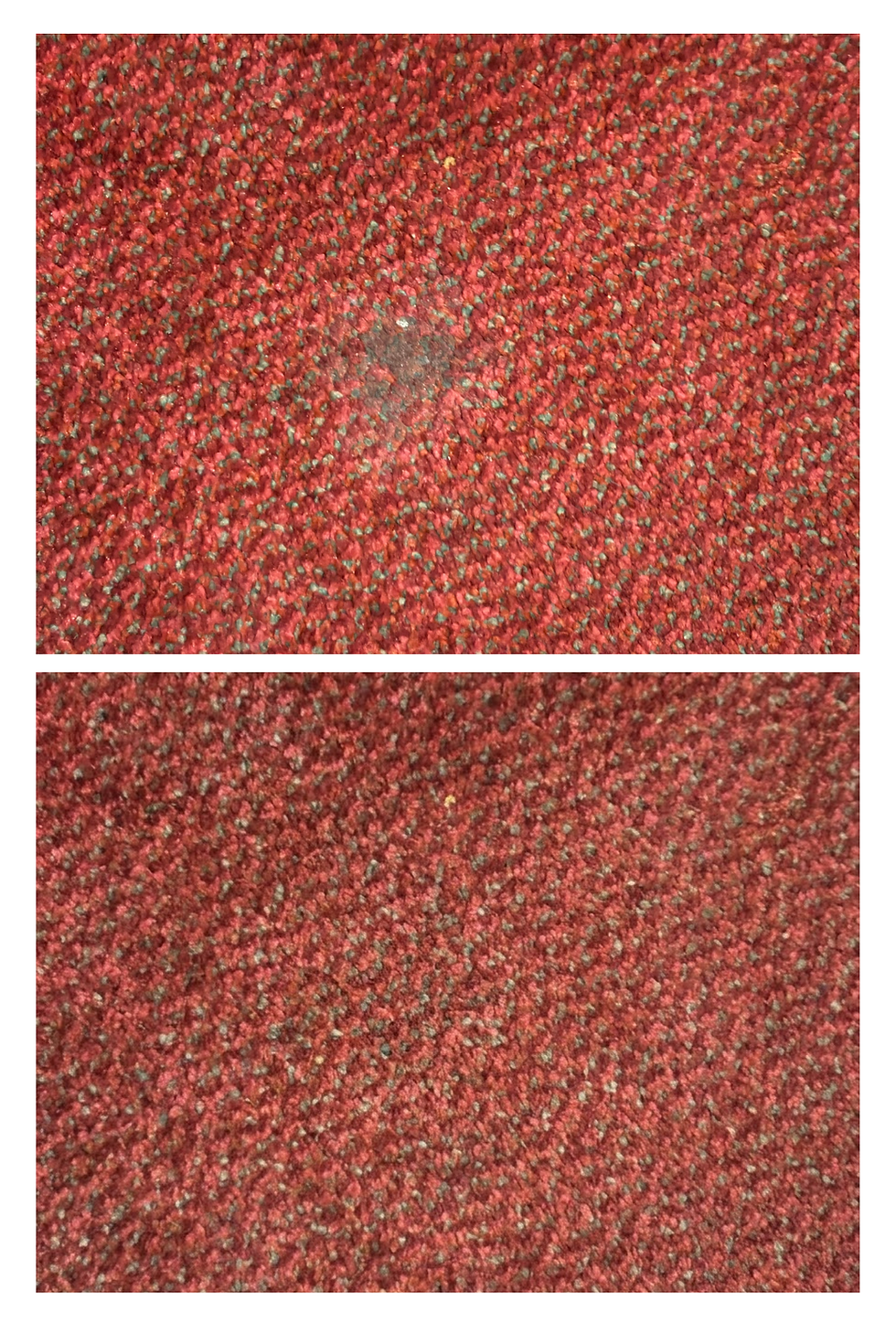
Genuine before-and-after detail from the real NW6 project, showing a band of dark soiling lifted from the carpet pile.
The final appearance is influenced by the carpet’s fibre, age, wear, stain history and previous treatment. Cleaning can improve the appearance of many carpets, but permanent staining, fibre damage, fading and wear may remain.

The same carpet after professional cleaning , the pile looks brighter and more even across the traffic lane.
What Professional Carpet Cleaning Equipment Does
Professional extraction equipment is designed to apply cleaning solution and recover moisture from the carpet. The machine’s performance, the operator’s technique and the carpet itself all affect the result.
The equipment can help a cleaner work more systematically than a basic household vacuum. It also allows the operator to control the cleaning process across different areas of the carpet.

Professional carpet cleaning machine/extraction unit
The equipment is only one part of the job. Correct inspection, product selection, controlled application and careful extraction matter too.
What Cleaning Solutions Are Used?
Professional cleaners may use different products depending on the carpet and the cleaning requirement. The same solution is not suitable for every fibre.
Mr Clean’s genuine project media includes Prochem Liquid Woolsafe and Prochem Fibre & Fabric Rinse.

Prochem Liquid Woolsafe, a low-foam extraction cleaning concentrate for wool and stain-resistant carpets.
Prochem Liquid Woolsafe S781 is a low-foam extraction cleaning concentrate for wool and stain-resistant carpets. It is a WOOLSAFE-approved maintenance product, with a stated pH of 8.5. Its use still depends on the carpet, its construction and the manufacturer’s guidance.

Prochem Fibre & Fabric Rinse, an acidic rinse agent used to help neutralise alkaline cleaners and condition wet-cleanable fibres.
Prochem Fibre & Fabric Rinse B109 is a mildly acidic rinse agent and pH and colour stabiliser for carpets and upholstery. It can help neutralise alkaline cleaners and pre-sprays and condition wet-cleanable fibres. It is identified as WOOLSAFE approved and has a stated pH of 4.

Prochem Extraction Plus
Prochem Extraction Plus was supplied for the process. It should be described simply as a Prochem extraction-cleaning product used where appropriate. No further specification should be assumed without the relevant product information.
Do not mix cleaning chemicals yourself. Product selection and use should follow the product instructions, the carpet manufacturer’s guidance and appropriate professional practice.
Common Carpet Cleaning Mistakes to Avoid
Several well-intentioned approaches can create problems.
Using too much cleaning solution: More product can leave more residue.
Over-wetting the carpet: Excess moisture can extend drying and may create risks for some carpet constructions.
Treating an unknown fibre incorrectly: Wool, synthetic and blended carpets may respond differently.
Scrubbing aggressively: Forceful rubbing can disturb or damage the pile.
Using unsuitable household products: Some products can leave residues, affect colour or make later treatment harder.
Assuming every stain can be removed: Some marks are permanent, and some are linked to fibre damage or colour loss.
Ignoring care guidance: Manufacturer instructions should be considered before cleaning begins.
Professional cleaning is not magic. It is a controlled attempt to improve the carpet without creating a new problem.
How Can You Prepare Your Home for Carpet Cleaning?
A little preparation makes the appointment easier.
Remove small loose items from the carpeted areas.
Clear accessible walkways and floor space.
Discuss suitable furniture movement with the cleaner.
Point out stains, spills, odours and previous treatments.
Keep children and pets away from the working area where necessary.
Plan for limited access while the carpet dries.
Follow the cleaner’s ventilation and drying guidance afterwards.
If you are preparing a rented property, coordinate the carpet cleaning with other work. Our end of tenancy cleaning service may be relevant when the whole property needs attention rather than the carpets alone.
Professional Carpet Cleaning vs DIY Carpet Cleaning
Consideration | DIY cleaning | Professional cleaning |
Equipment | Usually uses a household machine or rented unit | Uses professional extraction equipment selected for the job |
Convenience | Requires collection, setup, operation and return | The cleaner manages the process |
Carpet knowledge | You may not know the fibre or construction | The carpet can be assessed before treatment |
Stain treatment | Easy to apply an unsuitable product | Treatment can be considered according to the mark and material |
Moisture control | Results depend heavily on the machine and technique | Application and recovery are managed by the operator |
Product risk | Household products may not suit the carpet | Products can be selected with the carpet and guidance in mind |
Time and effort | Can be physically demanding | Reduces the work required from you |
Heavily soiled carpets | May be difficult to improve consistently | Professional assessment and extraction may be more appropriate |
DIY cleaning can be reasonable for some routine situations. Professional help may be worthwhile when the carpet is heavily soiled, the fibre is uncertain, the property is changing hands or previous treatments have not worked.
Frequently Asked Questions
How often should carpets be professionally cleaned?
There is no single schedule for every household. Foot traffic, pets, children, carpet colour, fibre and personal preference all matter. Some people arrange a periodic refresh, while others book when visible soiling becomes difficult to manage.
Can professional carpet cleaning remove stains?
It may improve some stains, but no responsible cleaner should promise that every mark will disappear. Results depend on the substance, age of the stain, fibre, colourfastness, previous treatment and whether the carpet has been permanently damaged.
How long does carpet cleaning take?
The time varies according to the number and size of rooms, access, condition, furniture and the process selected. Ask for an estimate after the cleaner understands the scope of the work.
How long does a carpet take to dry?
Drying time varies with the carpet, moisture level, ventilation, room conditions, equipment and cleaning method. Follow the specific guidance provided after the appointment.
Can all carpets be wet cleaned?
No. Some carpets, rugs or constructions may require a different method or additional caution. An assessment should take place before wet cleaning.
Is professional carpet cleaning suitable for rented properties?
It can be useful when a property is being prepared for new tenants or when a tenancy is ending. Check the tenancy agreement and any landlord or agent requirements separately.
Should I vacuum before carpet cleaning?
Yes, unless the cleaner advises otherwise. Vacuuming helps remove loose soil and debris before the wet-cleaning stage.
Can old stains come out?
Some old stains can be improved. Others may have caused permanent colour change, fibre damage or deep discolouration. An inspection is the best way to discuss realistic expectations.
Professional Carpet Cleaning in Finchley and North London
Mr Clean Housekeeping Services provides professional carpet cleaning across North and North West London, including Finchley and surrounding areas such as North Finchley and East Finchley.
The practical next step is to discuss the carpet’s condition before choosing a service. That conversation can cover the fibre, visible marks, access, previous treatments and whether a standard or more intensive approach is appropriate.
You can review the professional carpet cleaning service or compare it with the premium carpet cleaning service. For carpets that form part of a wider property refresh, our deep cleaning service may also be relevant.
Conclusion: Cleaner, Fresher-Looking Carpets Without Unrealistic Promises
Regular vacuuming remains essential. But when a carpet has accumulated traffic-lane soil, localised marks or a generally tired appearance, professional cleaning may offer a more suitable next step.
The method should be based on the carpet in front of the cleaner. Fibre, construction, age, staining and manufacturer requirements all matter.
The genuine North West London example in this guide shows a visible improvement on one red carpet. It does not guarantee the same result for every carpet.
If your carpet is in Finchley, North Finchley, East Finchley or the wider North London area, contact Mr Clean Housekeeping Services to discuss your requirements and request a quote. A sensible assessment can help you decide whether professional cleaning is worthwhile. ✨


Comments